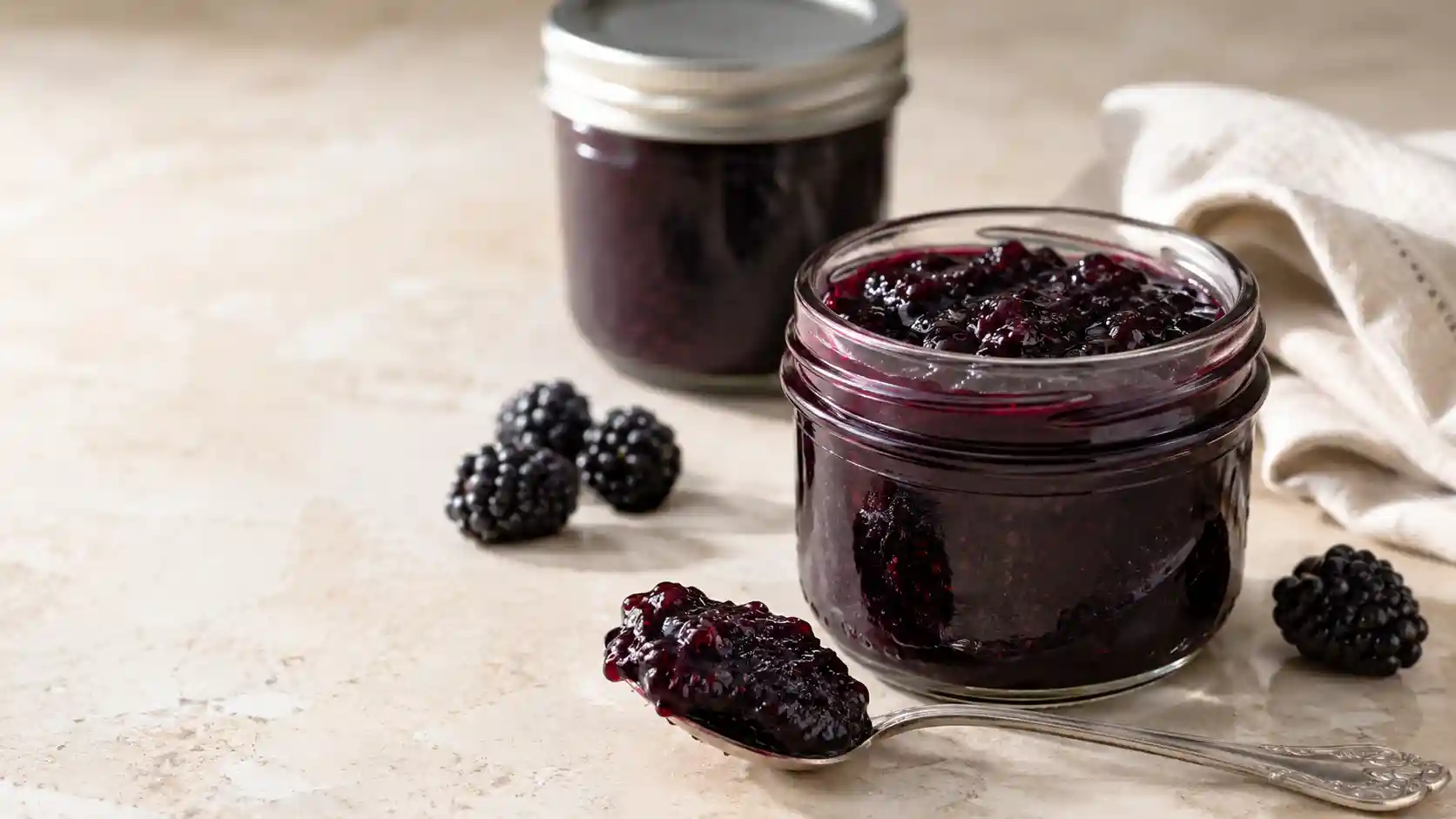
This blackberry jam recipe turns ripe berries into a rich, spreadable preserve using regular powdered fruit pectin and a traditional full-sugar formula. The recipe also includes an option for removing some of the seeds and clear processing times for different elevations.
This is a boiling-water canning recipe, not a refrigerator jam. Follow the ingredient quantities, jar preparation, headspace, and processing instructions exactly. The formula is based on the National Center for Home Food Preservation blackberry jam recipe.
Before You Make Blackberry Jam
Home-canned jam depends on the correct balance of fruit, pectin, sugar, heat, and processing time. Changing one part of that formula can affect how the jam sets and whether it matches the tested preservation method.
Measure the blackberries after crushing or straining them. Use regular powdered fruit pectin, add the full amount of sugar, and make only one batch at a time. Do not substitute liquid pectin or a low-sugar pectin unless you use a different recipe developed specifically for that product.
| Ingredient | Purpose | Can it be changed? |
|---|---|---|
| Crushed blackberries | Provide the fruit, flavor, color, and acidity. | Keep the measured amount at 6 cups. |
| Regular powdered fruit pectin | Helps the fruit and sugar form a gel. | Do not substitute liquid or low-sugar pectin. |
| Granulated sugar | Supports the gel, flavor, texture, and keeping quality. | Do not reduce it in this formula. |
Blackberry Jam Ingredients
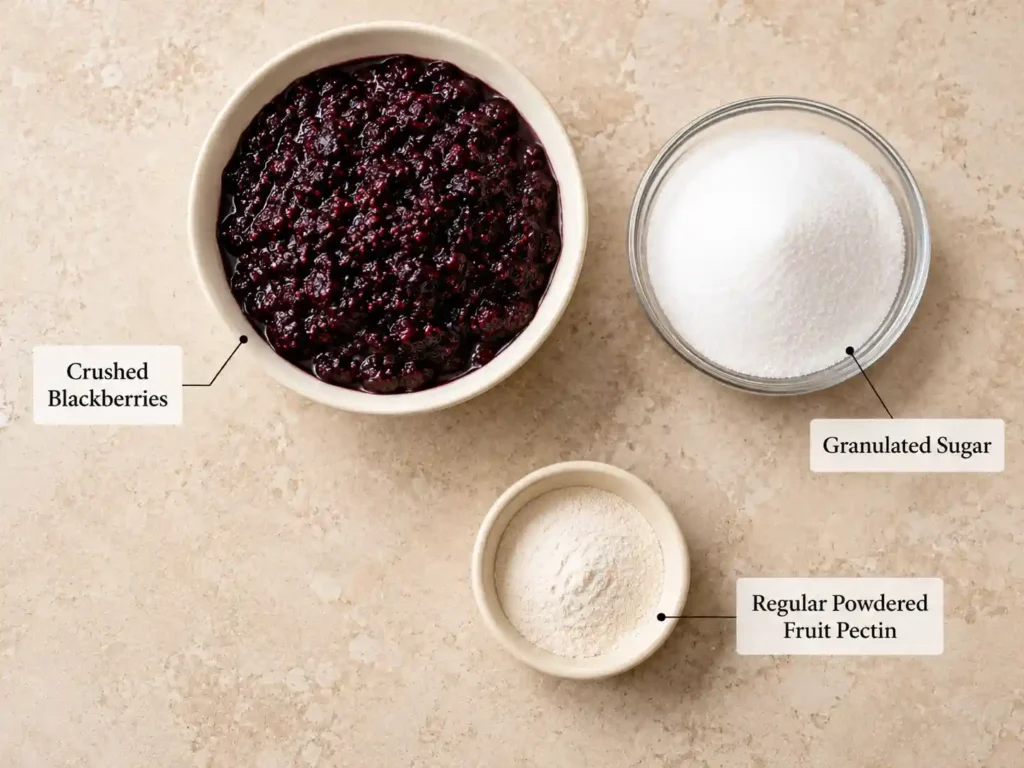
Ripe Blackberries
Choose fully ripe blackberries without mold, fermentation, or damaged areas. Sort and wash them, remove any stems or caps, and crush the fruit before measuring it.
You need exactly 6 cups of prepared crushed blackberries. The official recipe estimates that this begins with about three quart boxes of berries, but the final 6-cup measurement is what matters.
Regular Powdered Fruit Pectin
Use one standard package of regular powdered fruit pectin. The official formula lists one package rather than a weight, so do not combine partial packages or switch to another type of pectin.
Liquid pectin, no-sugar-needed pectin, and regular powdered pectin are not automatically interchangeable. Each type may require different ingredient ratios and a different order of preparation.
Granulated Sugar
This recipe requires 8 1/2 cups of granulated sugar. Measure it into a separate bowl before cooking so you can add it all at once when the fruit reaches a full boil.
Do not reduce the sugar in this version. A reduced-sugar blackberry spread requires a separately tested recipe and a pectin designed for reduced-sugar or no-sugar recipes.
Helpful Tools for This Recipe
Having the equipment ready before cooking is important because the jam moves quickly once it reaches a boil.
- Large nonreactive saucepan or preserving pan
- Boiling-water canner with a rack
- Half-pint or pint canning jars
- Two-piece canning lids
- Jar lifter
- Canning funnel
- Ladle
- Potato masher
- Fine-mesh sieve or food mill, optional
- Headspace measuring tool
- Clean damp paper towel for wiping jar rims
- Clean kitchen towel or cooling rack
How to Make Blackberry Jam
1. Prepare and Sterilize the Jars
Wash the jars in hot, soapy water and rinse them well. Check each jar for cracks, chips, or damage around the rim.
Because this recipe has a processing time as short as 5 minutes, the jars must be sterilized before filling. Place the clean empty jars upright on the canner rack. Fill the jars and canner with hot water so the water stands at least 1 inch above the jar tops.
Boil the empty jars for 10 minutes at elevations below 1,000 feet. At higher elevations, add 1 additional minute for every additional 1,000 feet. Keep the jars hot until you are ready to fill them.
Prepare the two-piece lids according to the current manufacturer instructions.
2. Crush and Measure the Blackberries
Sort and wash the fully ripe blackberries. Remove stems or caps, then crush the berries with a potato masher.
If you want to keep all the seeds, measure 6 cups of crushed fruit directly into your large saucepan.
For a smoother jam, pass part or all of the crushed berries through a fine-mesh sieve or food mill. Measure the fruit after straining. You still need exactly 6 cups of prepared fruit.
3. Add the Powdered Pectin
Add one package of regular powdered fruit pectin to the 6 cups of crushed blackberries. Stir until the pectin is evenly distributed.
Place the saucepan over high heat. Stir constantly as the mixture heats to prevent scorching.
4. Reach a Full Boil
Bring the blackberry and pectin mixture quickly to a full boil. The entire surface should be covered with active bubbles, and the boiling should continue even while you stir.
Do not start the final one-minute cooking time yet. The sugar must be added first.
5. Add the Sugar
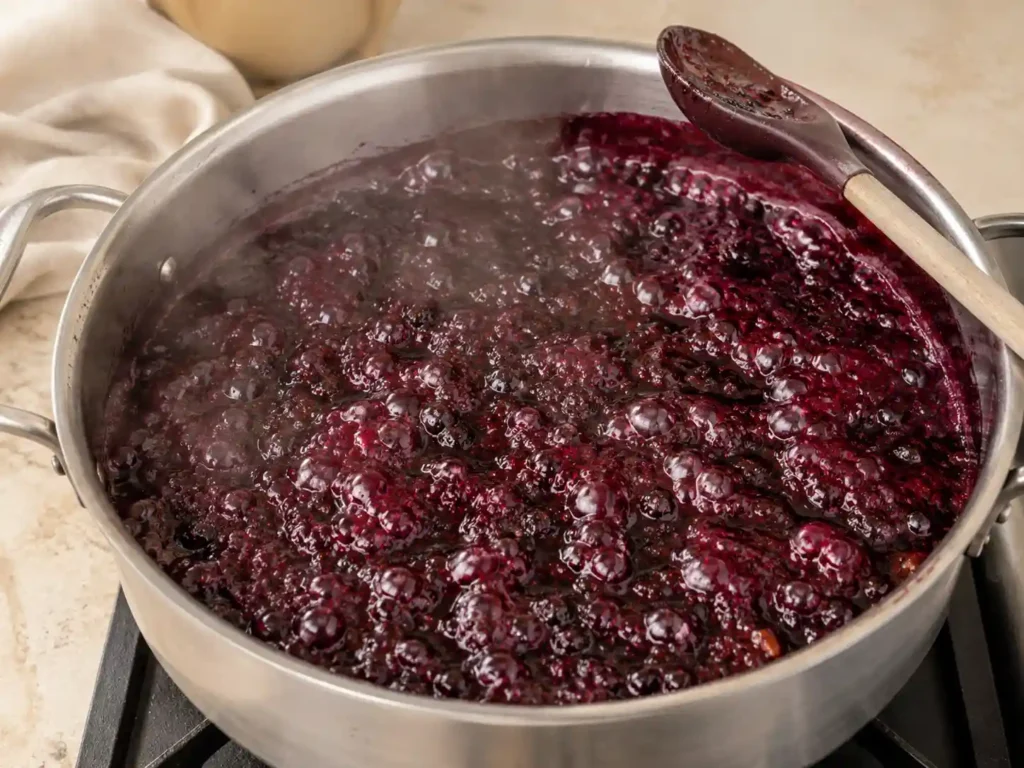
Add all 8 1/2 cups of granulated sugar at once. Continue stirring as the sugar dissolves.
Return the mixture to a full bubbling boil over high heat. Once the entire surface boils vigorously and the boil cannot be stirred down, start the timer.
6. Boil for One Minute
Boil the jam hard for exactly 1 minute while stirring constantly. Remove the saucepan from the heat as soon as the minute is complete.
Skim off surface foam if needed. Work promptly so the jam does not begin setting in the saucepan.
7. Fill the Jars
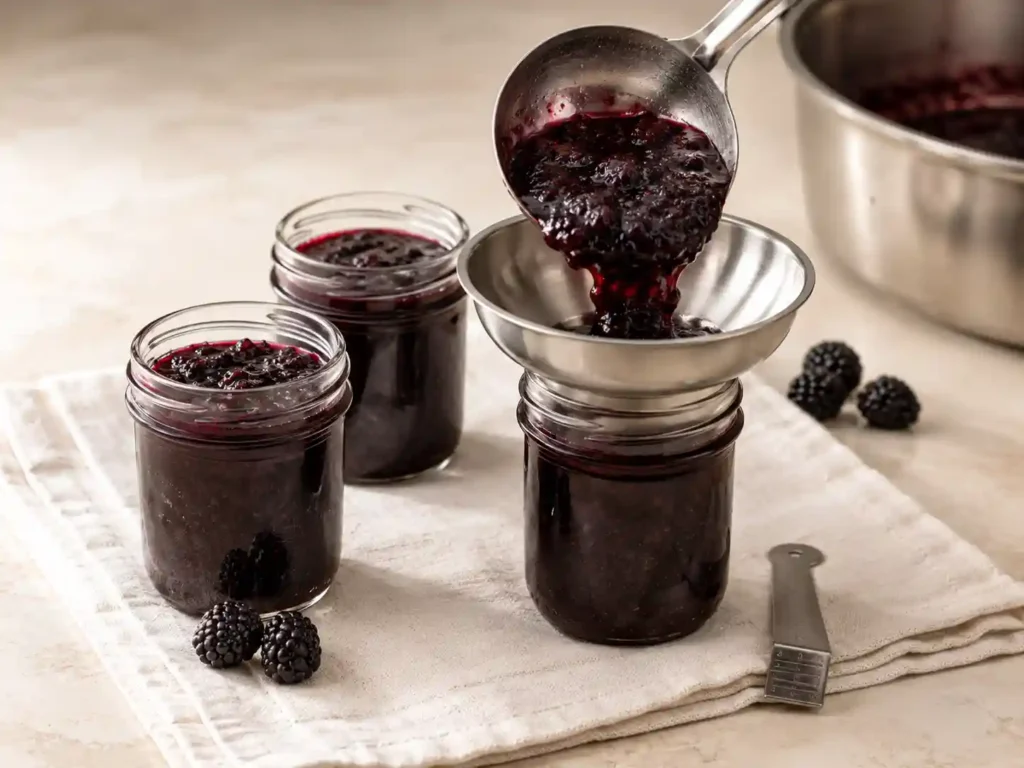
Remove one hot sterilized jar at a time. Ladle the hot jam into the jar through a canning funnel, leaving 1/4-inch headspace.
Wipe the rim with a damp, clean paper towel. Center the prepared lid over the jar and apply the screw band according to the lid manufacturer’s instructions.
Return the filled jar to the canner rack and continue until all the jam has been packed.
8. Process the Blackberry Jam
Make sure the water covers the filled jars by at least 1 inch. Cover the canner and bring the water to a vigorous boil.
Begin timing only after the water has returned to a complete boil. Keep the canner covered and maintain a continuous boil for the entire processing time.
If the water stops boiling at any point, return it to a full boil and restart the complete processing time from the beginning.
| Elevation | Jar size | Processing time |
|---|---|---|
| 0 to 1,000 feet | Half-pint or pint | 5 minutes |
| 1,001 to 6,000 feet | Half-pint or pint | 10 minutes |
| Above 6,000 feet | Half-pint or pint | 15 minutes |
9. Cool and Check the Jars
When the processing time is complete, turn off the heat and remove the canner lid carefully, directing the steam away from your face. Wait 5 minutes before lifting the jars from the canner.
Remove the jars one at a time with a jar lifter. Keep them upright and place them on a clean towel or cooling rack with at least 1 inch of space between them.
Let the jars cool undisturbed for 12 to 24 hours. Do not press the lid centers or retighten the screw bands while the jars are cooling.
After cooling, remove the bands and check each seal. A sealed lid should curve slightly downward and should not spring up when pressed. Refrigerate any unsealed jar and use it first.
Seeded or Smoother Blackberry Jam
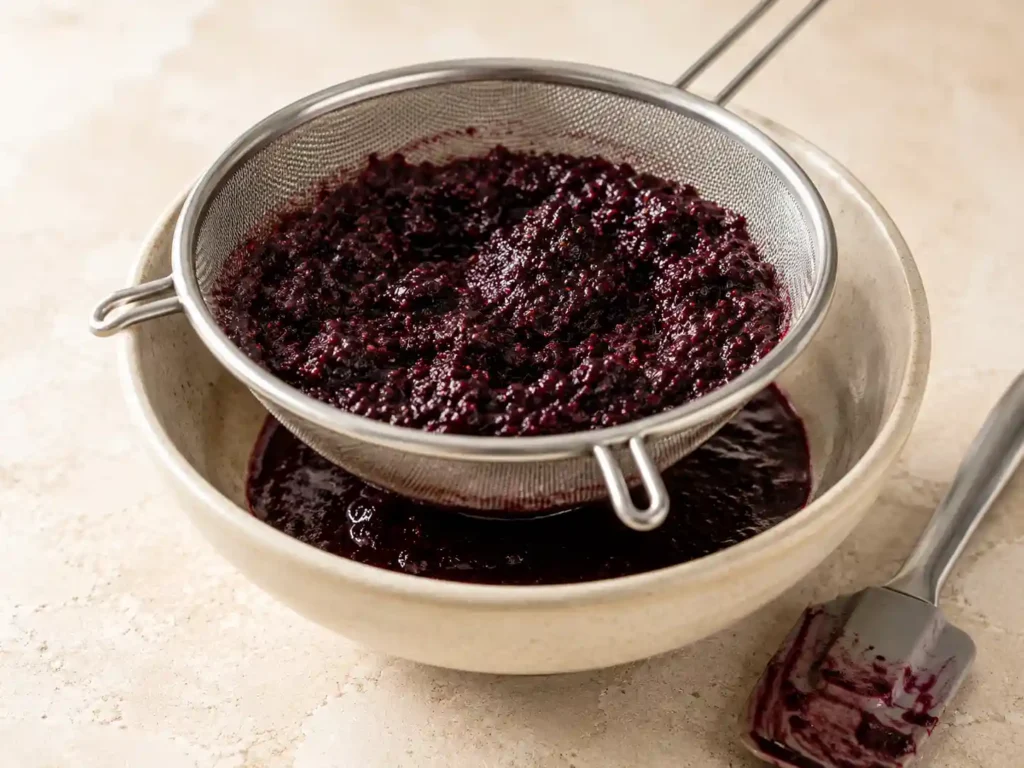
Blackberry seeds are edible, but their texture can be noticeable in jam. You can keep all the seeds for a rustic preserve, remove part of them for a balanced texture, or strain all the prepared fruit for the smoothest result.
Straining only part of the fruit is often a practical middle ground. You keep some of the character of the berries without making the finished jam heavily seeded.
Always measure the fruit after the desired amount of straining. Do not start with 6 cups and then remove a large amount of pulp and seeds, since that would change the fruit-to-pectin ratio.
Common Blackberry Jam Problems
| Problem | Possible cause | How to prevent it |
|---|---|---|
| Jam is too soft | Incorrect fruit measurement, wrong pectin, reduced sugar, or an incomplete boil | Measure prepared fruit accurately and follow the formula exactly. |
| Jam is too firm | Overcooking or too much pectin | Boil hard for only 1 minute after the mixture returns to a full boil. |
| Jam scorches | Insufficient stirring or a pan that is too small | Use a large saucepan and stir constantly during both boiling stages. |
| Sugar crystals form | Undissolved sugar or sugar left on the sides of the pan | Add the measured sugar at once and stir thoroughly as the jam returns to a boil. |
| Jar does not seal | Food on the rim, a damaged jar, an improperly applied lid, or incomplete processing | Inspect jars, wipe rims carefully, use prepared lids, and process for the full time. |
| Mold or fermentation appears | Spoilage or a failed seal | Discard the entire contents. Do not scrape off mold and use the remaining jam. |
How to Serve Blackberry Jam
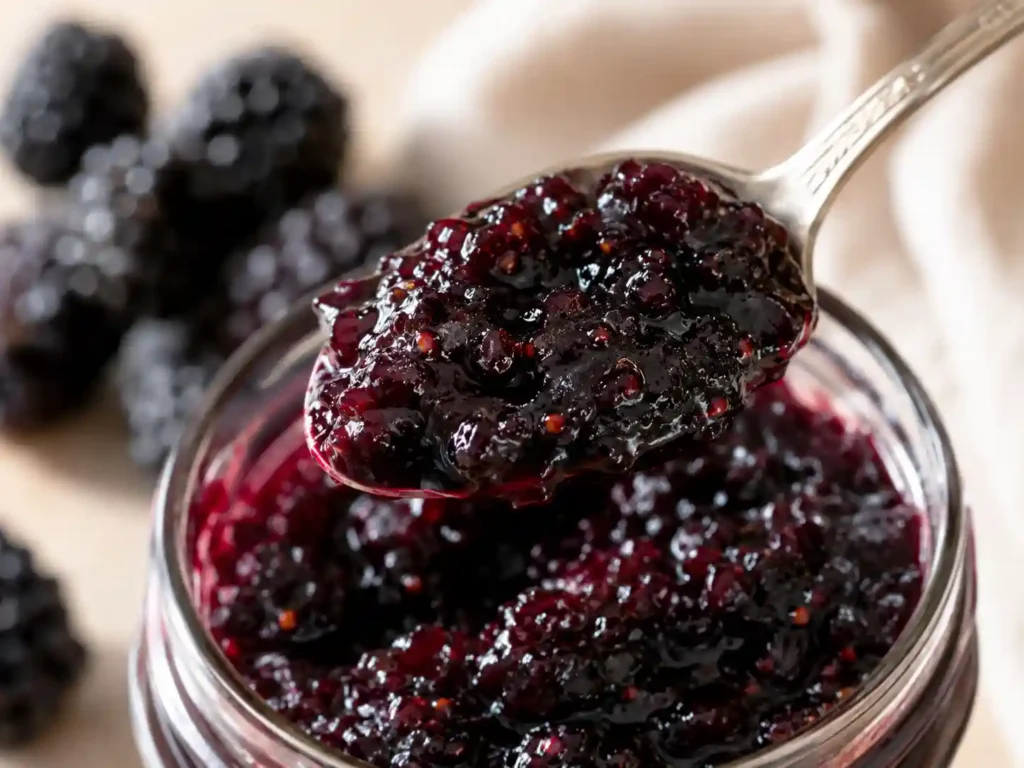
Spread the jam over toast, warm biscuits, English muffins, or scones. It also makes a colorful topping for oatmeal, plain yogurt, waffles, or pancakes.
Try it with this pancake recipe from scratch or these Greek yogurt pancakes.
The jam can also be paired with homemade Gipfeli or used carefully as a filling for homemade pop tarts. Avoid overfilling pastries because heated jam can leak around the edges.
For another seasonal fruit preserve, see this strawberry rhubarb jam recipe.
How to Store Home-Canned Blackberry Jam
After checking the seals, remove the screw bands and wash away any sticky residue from the jars and lids. Dry the jars, label them with the recipe name and date, and store them without the bands.
Keep sealed jars in a clean, cool, dark, dry place. For the best color, texture, and flavor, use properly processed home-canned jam within one year.
Refrigerate the jam after opening. Traditional full-sugar, pectin-added jam generally keeps its best refrigerated quality for about one month after opening, although the exact condition depends on handling and storage.
Discard the entire jar if you notice mold, yeast growth, leakage, fermentation, a broken seal, or an unusual odor. Do not taste jam that shows signs of spoilage.
Seasonal recipe tip: Save this recipe or subscribe to the ZikoRecipes newsletter so you can find it again when blackberry season arrives.
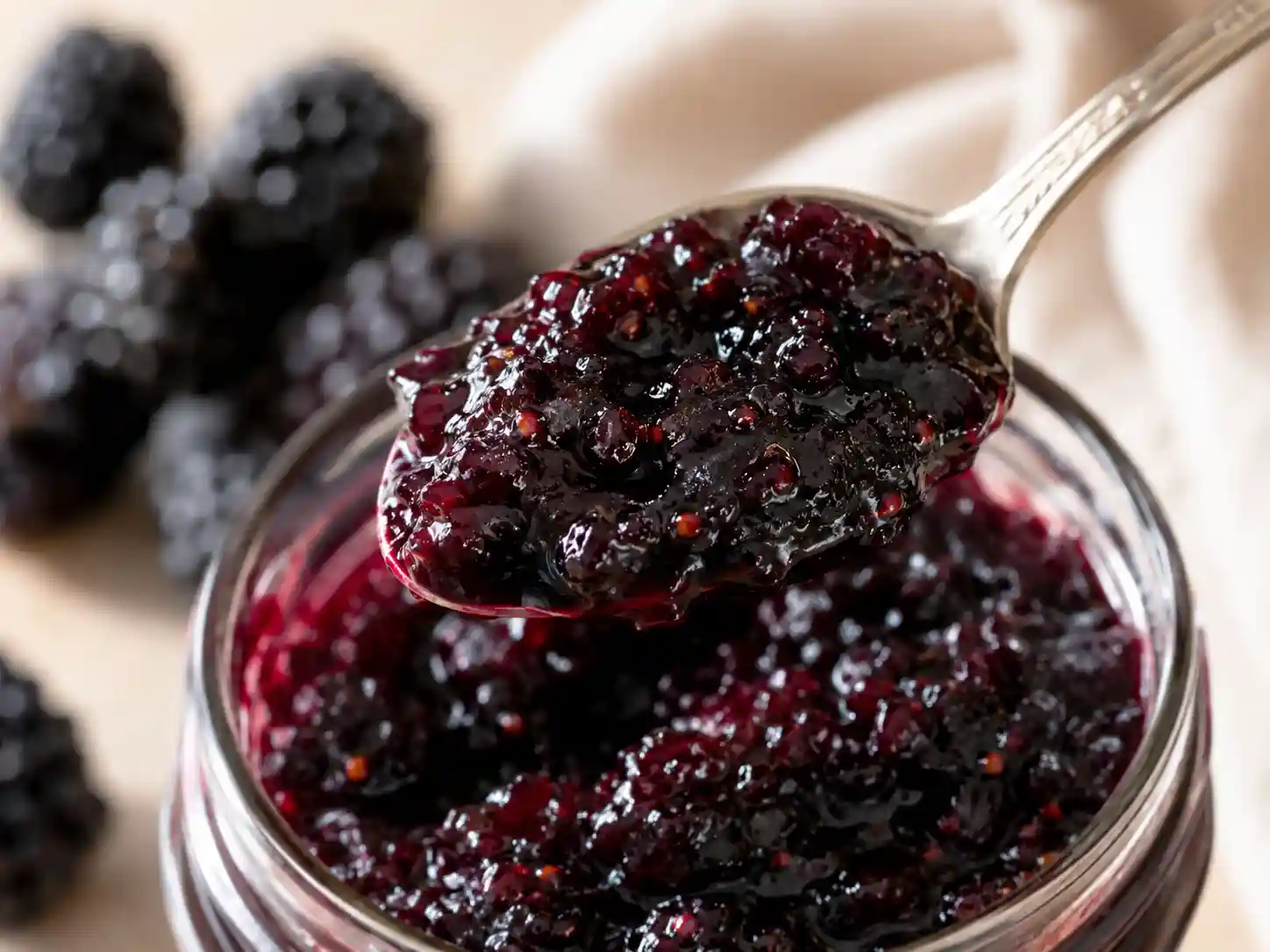
Easy Blackberry Jam Recipe With Pectin
Ingredients
Equipment
Method
- Wash the canning jars in hot, soapy water and rinse well. Inspect each jar for cracks, chips, or rim damage.
- Place the clean empty jars upright on the canner rack. Fill the jars and canner with hot water so the water stands at least 1 inch, or 2.5 centimeters, above the jar tops.
- Sterilize the empty jars by boiling them for 10 minutes at elevations below 1,000 feet. At higher elevations, add 1 additional minute for every additional 1,000 feet. Keep the jars hot until filling.
- Prepare the two-piece canning lids according to the manufacturer’s current instructions.
- Sort and wash the ripe blackberries. Remove any stems or caps, then crush the berries with a potato masher.
- For a smoother jam, pass part or all of the crushed berries through a fine-mesh sieve or food mill. Measure the fruit after straining. You must have exactly 6 cups, or approximately 865 grams, of prepared fruit.
- Transfer the measured blackberries to a large nonreactive saucepan. Add the regular powdered fruit pectin and stir until evenly distributed.
- Place the saucepan over high heat. Stir constantly and bring the blackberry mixture quickly to a full bubbling boil that continues even while stirred.
- Add all the granulated sugar at once. Continue stirring while the sugar dissolves.
- Return the mixture to a full bubbling boil that cannot be stirred down. Once the entire surface is boiling vigorously, start the timer.
- Boil hard for exactly 1 minute while stirring constantly. Remove the saucepan from the heat immediately when the minute is complete.
- Skim off any surface foam if necessary. Work promptly so the jam does not begin setting in the saucepan.
- Remove one hot sterilized jar at a time. Ladle the hot jam through a canning funnel, leaving 1/4-inch, or approximately 6-millimeter, headspace.
- Wipe the jar rim with a clean damp paper towel. Center the prepared lid over the jar and apply the screw band according to the lid manufacturer’s instructions.
- Return each filled jar to the canner rack. Make sure the water covers the jars by at least 1 inch, or 2.5 centimeters.
- Cover the canner and bring the water to a vigorous boil. Begin timing only after the water has returned to a complete boil.
- Process half-pint or pint jars for 5 minutes at elevations from 0 to 1,000 feet, 10 minutes at 1,001 to 6,000 feet, or 15 minutes above 6,000 feet.
- Maintain a continuous boil for the entire processing time. If the water stops boiling, return it to a full boil and restart the complete processing time from the beginning.
- When processing is complete, turn off the heat and carefully remove the canner lid, directing the steam away from your face. Wait 5 minutes before removing the jars.
- Lift the jars upright with a jar lifter and place them on a clean towel or cooling rack, leaving at least 1 inch of space between them.
- Let the jars cool undisturbed for 12 to 24 hours. Do not press the lid centers or retighten the screw bands while the jars cool.
- After cooling, remove the screw bands and check each seal. A sealed lid should curve slightly downward and should not spring up when pressed. Refrigerate any unsealed jar and use it first.
- Wash away any sticky residue, dry the sealed jars, label them with the recipe name and date, and store them without the screw bands in a cool, dark, dry place.
Notes
Frequently Asked Questions
Can I reduce the sugar in this blackberry jam recipe?
No. Do not reduce the 8 1/2 cups of sugar in this traditional powdered-pectin formula. Use a separate tested recipe with a reduced-sugar pectin when you want a lower-sugar fruit spread.
Can I double the recipe?
No. Make one batch at a time. Doubling a jam recipe can change how quickly it heats and evaporates, which can prevent the jam from setting correctly.
How do I remove blackberry seeds?
Crush the berries, then press part or all of the fruit through a fine-mesh sieve or food mill. Measure the strained fruit after removing the seeds so you still use exactly 6 cups.
Why did my blackberry jam not set?
Possible causes include using the wrong type of pectin, reducing the sugar, measuring the fruit incorrectly, failing to reach a full boil, or changing the batch size. Overcooking can also damage the final texture.
How long does home-canned blackberry jam keep?
For best quality, use properly sealed and processed jars within one year. Refrigerate opened jars and aim to use traditional full-sugar jam within about one month for the best quality.
Food Safety References
- National Center for Home Food Preservation: Blackberry Jam With Powdered Pectin
- National Center for Home Food Preservation: Sterilization of Empty Jars
- National Center for Home Food Preservation: Using Boiling-Water Canners
- National Center for Home Food Preservation: Storing Home-Canned Jams and Jellies